When glass containers are being used, these are transferred over an infeed worm and infeed starwheel to plastic jaw grippers. The plastic clamps developed especially for the rinser, firmly hold the bottles at the bottle neck and at the body. Unlike this, plastic containers are picked up from the air conveyor by a spacing starwheel for transfer to the clamp where they are then held firmly at the neck ring.
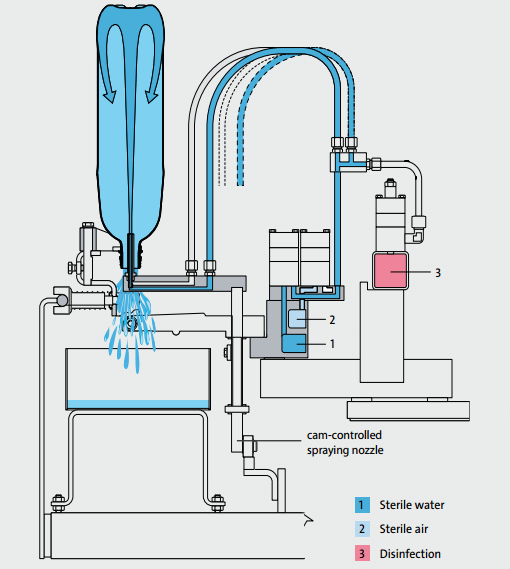
There is no need to replace the spacing starwheel when changing container sizes. Following bottle inversion where the containers are swung upwards through 180°, the actual cleaning process starts. The spraying nozzle is positioned directly underneath the neck finish for injecting the particular rinsing medium into the bottle. The spraying nozzles are supplied with medium from the rotary media manifold. Following these treatment phases, the bottle is returned to the upright position and transferred to the discharge starwheel. For versions with an electro-pneumatic control unit, a user-adjustable rinsing angle is available for the cleaning steps. The respective treatment times can be defined individually
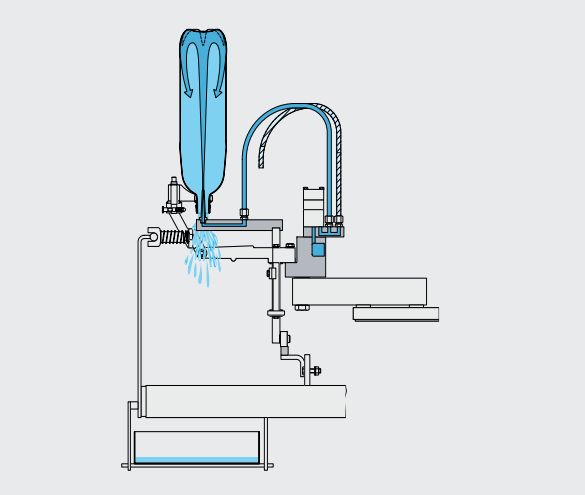
The single-channel rinser is ideal for
straightforward applications, where
water for example, is distributed in
the bottle from the spraying nozzles.
Fitted with a rigid or optionally
available controlled spraying nozzle,
the single-chamber rinser can be
accordingly adjusted for the particular
application case.
The controlled spraying nozzle
ensures that the rinsing medium
reaches the whole inside area of the
bottle and that the cleaning medium
is used as efficiently as possible.
The single-channel and doublechannel
rinsers are available both as
mechanical and as electro-pneumatic
versions. In the mechanical version,
the rinsing process is cam-controlled.
In the variant with electro-pneumatic
valves, this process is controlled by
a central control unit. The threechannel
rinser is only available with
an electro-pneumatic control unit
because of the greater complexity of
the processes involved.
The two-channel rinser is the ideal system for those applications where two different media shall be used for rinsing the containers. The media selected beforehand can be used in succession from two separate channels. There is also the possibility with this method to use water and air, or disinfectant and air, at the same time during the rinsing operation.
In a special variant of the two-channel rinser with eletropneumatic control, ionised air can also be used as rinsing medium for PET bottles. Precipitating particles of dust are sucked from the second channel. Using air as the rinsing medium makes CIP and foam cleaning superfluous.
In the three-channel rinser, different media are used in succession for the containers. Thus water, sterile air and steam for example can be used. The supply of water and sterile air is through the channels integrated in the gripper support whereas the channel for the steam has been designed as a separate channel to allow for thermal expansion. It is possible with this method to first use disinfectant and air together and then to repeat the process with water and air.
The threechannel rinser is only available with an electro-pneumatic control unit because of the greater complexity of the processes involved.